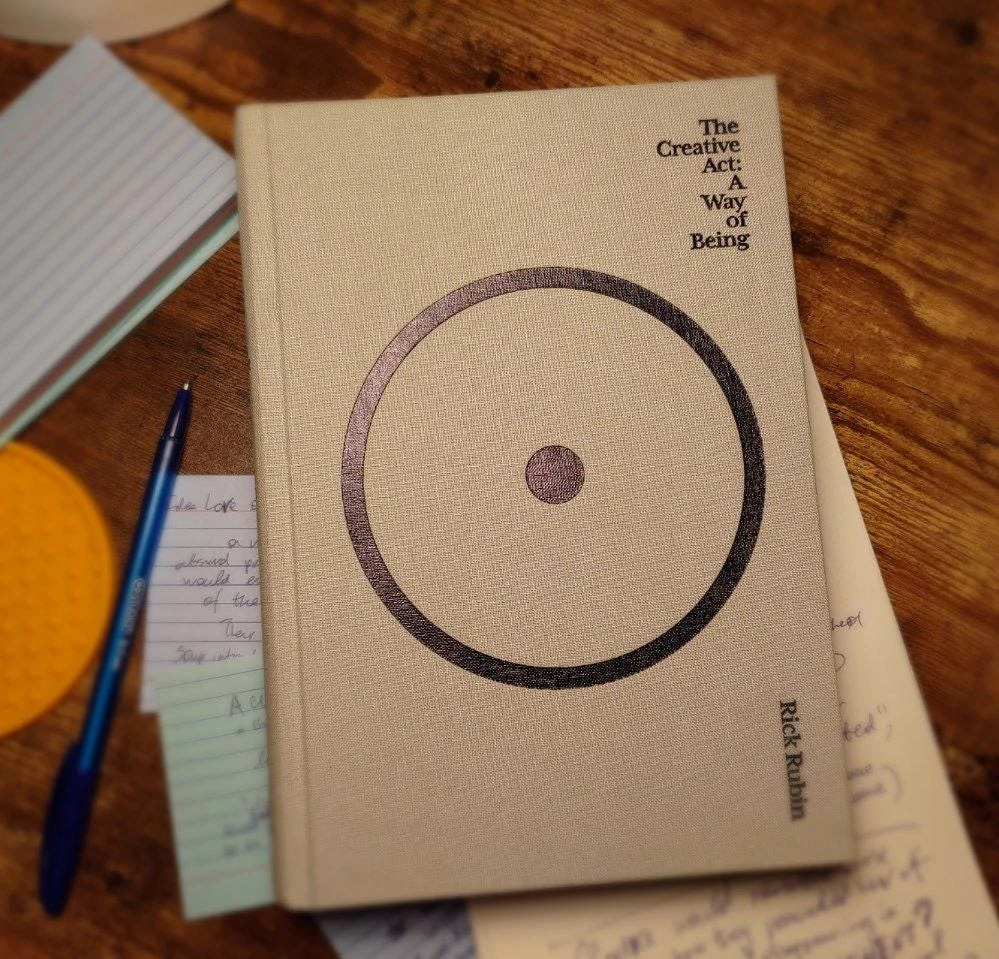
As much as I like a good book, I hate any book that tries to bullshit me. That’s why I’m not a fan of “self-development” genre, as 90% of it consists of books whose authors boldly provide concrete steps to success (whatever that “success” might be—starting a business, becoming a piano player, improving your social skills, etc.). The problem is that they usually base their “instructions” on their own experience, which often is an example of survival bias.
Simply put, if you did something very cool, don’t tell others to take the exact same steps to reproduce what you did. What are the chances that the context of your life, along with your skill level, would be exactly the same as your readers’? Zero. Sure, there will be similarities, but that's it—no exact match is possible.”
Still, such BS literature has always sold well, as we all want, at some point, magic advice that will get us straight to the goal. Rick Rubin’s book kicks off with a unique voice and keeps you indulged for quite long, but inevitably, you figure that it belongs to this genre.
Mr. Rubin takes you by the hand and, in a soft tone, shares his thoughts on art as a process. Then, as a way of living. It all starts off riveting but soon slips into pseudo-intellectual, pseudo-philosophical mumbling. Yet, in this new-age'y train of thought, Rick manages to surprise you consistently, delivering postulates that hit the nail on the head. You stare at the book, thinking, “wow, it’s always been lying on the surface, but I never noticed that”. It’s not that the author gives you a new perspective, it’s rather he finds the right words to complement observations that you’ve already made.
And that’s the biggest advantage of the book, for which I forgave Rick for a lot of stuff. For being pretentious at times. For giving the “exact steps to take”, jeez. For contradicting himself, here and where.
Yet he always managed to fix the situation by saying something like “it’s not the only path”, or, “you can do it either way or not doing at all”, etc. Out of context, it might look like vague shitposting, but believe me, it’s not (mostly). Sometimes it is, so be ready to roll your eyes while reading.
Another crucial facet of this book is that it manages to validate your feelings as a creator. All those ruminations about “whether I’m good enough” or “I shouldn’t release it until it’s perfect”, and tons of others are mentioned by Rick, so you don’t feel like garbage. A couple of times, the author even admits that he did think the same thing, which can support you even more.
So while reading, I was in a love-hate relationship with the book. The closer I got to the end, the more I grieved that it was ending. “The art of being” became the second “self-dev” book that I actually finished, instead of dropping after 50’ish pages. In the end, I figured that I loved it with all its bullshit and will return to the book sporadically. By flipping to random pages, I’ll get that vibe of a mentor who, for the most part, doesn’t try to be a mentor but a human being sitting next to you in the same boat.
By flipping to random pages, I’ll get that vibe of a mentor who, for the most part, doesn’t try to be a mentor but a human being sitting next to you in the same boat.