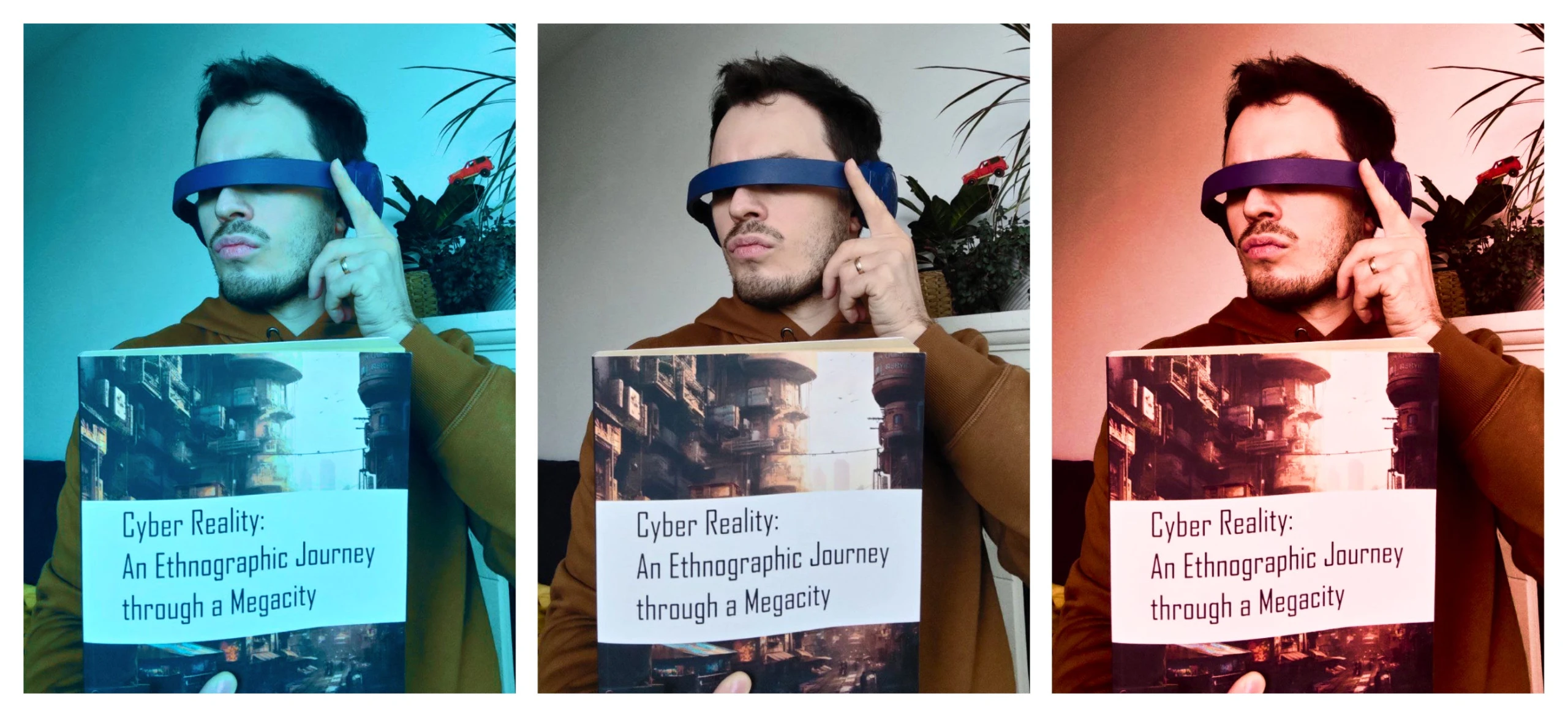
Short review
I didn't fall into this book at first, but after some tension, I appreciated it fully and would strongly recommend it to anybody who likes the cyberpunk genre.
Longer review
What’s what?
That's a book about a group of anthropologists who embarked on a project to study a dystopian megacity in North America. The events took place in the not-so-far future where the concepts of classic cyberpunk took over.
The book combines two different approaches: it's a fiction story with a plot, and it's also a reference for world-building in the manner of D'n'D. After each fiction chapter, there's one or more appendices with descriptions of classes, their characteristics, etc. As I'm not a D'n'D master, I wasn't much interested in the reference part of the book, so I skipped most of the appendices. However, the parts that I read provided additional info on what I just read in the main story. Still, those bits weren't of ultimate importance for understanding the plot, as the fiction part was self-sufficient throughout the book, which is really good. Such an approach allow readers to decide for themselves how deeply they wanna explore the world. That's a wise design indeed. I chose to read through the story and spent little time to examining the appendices, so my review is mostly about the plot and doesn't comment on the quality and intricacy of the reference part.
Suspension of disbelief
The book started with the author's introduction, where he revealed some personal circumstances that nudged him to create this book. Right after, the first chapter began, and… For some reason, I still perceived it like it was the author himself but not the lyrical hero. Maybe it was because the language was the same as in the introduction. That was confusing and even slightly repulsive as my suspension of disbelief, well… it wasn't there almost all the time during the first chapters. I just didn't believe the narrative fully, which prevented me from delving into the world of the book.
However, I gradually adjusted my perception, and that's when I began to truly enjoy the book. The way the author meticulously described the world of the future, its inhabitants, their habits and vices, was remarkable. I got immersed in the mission of the anthropologists to the extent that I was almost making notes myself, as they had been doing along the way. I was sincerely rooting for those guys, wishing nobody would harm them because of their mission. And boy, they got into a couple of tense situations! I will not spoil anything except for stating the fact that the tense moments were scarce and that made them stand out within the narrative. Let's call those moments "surges".
Not gonna lie, after the very first surge, I was equally excited and disappointed because I wish for something like that would be a bit more often. To that moment, I already got used to the fact that the book was more like a scientist's diary, a pseudo-documentary prose, sth neither stale nor exciting. And then – boom! — the author cheered me with sth vigorous. I didn't see that coming, but I craved more immediately. I got nothing but the diary going on. As frustrated as I was then, as much grateful as I became later. This is because I adjusted to the author's decision to present "surges" rarely.
My two initial hardships – not believing in the narrative and craving for more plot twists – and how the author eventually won me over show the main advantage of this book: it can shift your expectations. It happens rarely. To me, this is usually a sign of a honed skill and/or that the book definitely has a soul. I wouldn't comment much on how skillful the author is, because, to my knowledge, it's his first book, so it's premature to make any conclusions on writing mastery yet. So I'd rather say that for the debut its writing is solid. What I'm sure about is that this book has a soul, a piece of the author's heart trembling with the bittersweetness that he might get through in his life.
True cyberpunk
A couple of words on the world of "Cyber Reality." Since the very first chapter, I'd been catching myself that this detail seems familiar, oh, and that approach should've been in a movie that I saw, and so on. True, the author gathered under one roof tons of things that I might see in cyberpunk games and movies. That was a bold decision as such an approach often leads to making the world feel secondary, sewn from clichés and thus forcing the reader to trudge through instead of strolling around. Luckily, the world seemed familiar in the best meaning of this word. It was cozy to recognize those references; I felt like I skimmed some iconic cyberpunk features. It was a slippery slope on which the author danced yet not failed to deliver a cohesive world.
That's ironic that I felt cozy, as the world wasn't cozy at all. I saw a classic cyberpunk city, which means a gloomy space with "high tech, low life." That brings another advantage of this book: it shows TRUE cyberpunk. If you're consuming a piece of cyberpunk art and you wanna appear in its world, then it's not cyberpunk, rather postcyberpunk or whatever. Quite the opposite, if you're realizing that the world the author presented you with is frightening and you'd never wanted to live in a place like that, it is cyberpunk at its best. I can't emphasize how important it is for the genre to have books like this one; many other modern games and books show vivid, colorful worlds yet they claim it to be cyberpunk when it's not. I think those artworks create incorrect representations of the genre, which I don't like at all.
Speaking of world representation, there are many illustrations in this book crafted by the author himself, which is impressive. Most illustrations are character portraits. To my taste, some of the portraits were too slick for the gloomy world they should belong to, but hey, it's a one-person product! It cannot and should not be perfect. If it were, it would be boring and not worth such a lengthy review.
Last but not least, is the angle from which I saw this world. The world features could have been borrowed from other works, but the angle... I've never seen a cyberpunk work where the protagonist is an anthropologist, a scientist studying people, their lives, addictions, social dynamics, etc. It is unique and can't be overestimated in its value for the genre.
Wrap-up
My verdict is that "Cyber Reality" is a strong debut that manages not only to deliver an engaging story but also add something new to the genre. If you're into cyberpunk and enjoy non-conventional ways of looking at familiar themes, it's a must-read.
Buy the book on Amazon: https://www.amazon.ca/gp/product/B0CDJ7M77S
Shelve the book on Goodreads: https://www.goodreads.com/book/show/195594671-cyber-reality